By Austin Wilson, Modern PPC
The short answer
If you own a plumbing company, both Google Search Ads and Local Services Ads can help homeowners find your business. But which one should you start with?
My recommendation: test Local Services Ads first if you’re eligible, your profile is competitive, and your team answers leads reliably. Test Google Search Ads first if you want to prioritize particular services, need control over the message and landing page, or can’t use LSA in your market. With a limited budget, run one before adding the other.
The goal is more profitable booked jobs. Here’s how to decide where to start.
Key takeaways
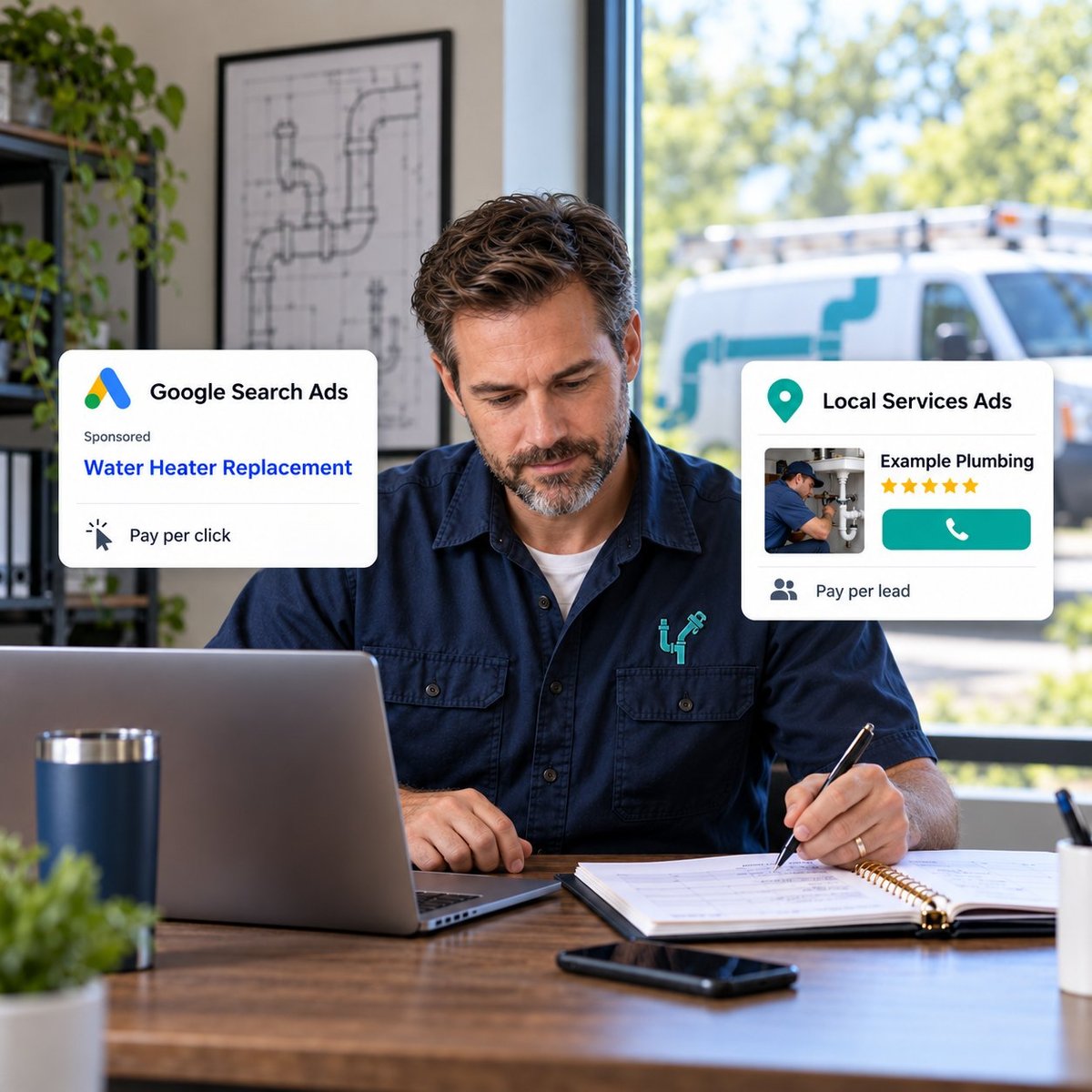
- Google Search Ads charge for clicks, so you pay whether or not the visitor becomes a lead. Local Services Ads charge for leads that meet Google’s criteria.
- Search Ads give you control over which services you promote and what homeowners see after clicking. LSA matches you to the job types in your profile instead.
- Neither channel guarantees booked work. The number that matters is ad spend per booked job, not cost per click or cost per lead.
- With a limited budget, test one channel first. Splitting spend across both usually leaves each with too little activity to judge.
- LSA is the usual starting point when you are eligible and your team answers reliably. Search Ads are the usual starting point when you want to prioritize specific services.
What’s the difference between Google Ads and Local Services Ads?
In this article, “Google Ads” means Google Search Ads, and “Local Services Ads” means Google Local Services Ads.
Google Search Ads
Local Services Ads
Customer experience
Google Ads:A homeowner clicks an ad and visits your landing page
LSA:A homeowner contacts you through your business profile
What you generally pay for
Google Ads:Clicks
LSA:Leads that meet Google’s criteria
Targeting approach
Google Ads:Keywords, location settings, and other campaign controls
LSA:Available job types, service areas, and profile relevance
Main advantage
Google Ads:More control over the service, message, and landing experience
LSA:A direct path from your profile to a customer inquiry
What still needs to happen
Google Ads:Turn the visit into an inquiry, then a booked job
LSA:Qualify the inquiry and turn it into a booked job
Paying for a lead does not guarantee a booked job. Your team still needs to respond, confirm that the request fits your business, and win the customer.
When Google Search Ads may be the better starting point
Google Search Ads give you more control over the services you promote and what homeowners see after clicking.
That makes them useful when you want to prioritize particular jobs, such as water heater replacements or water main installations.
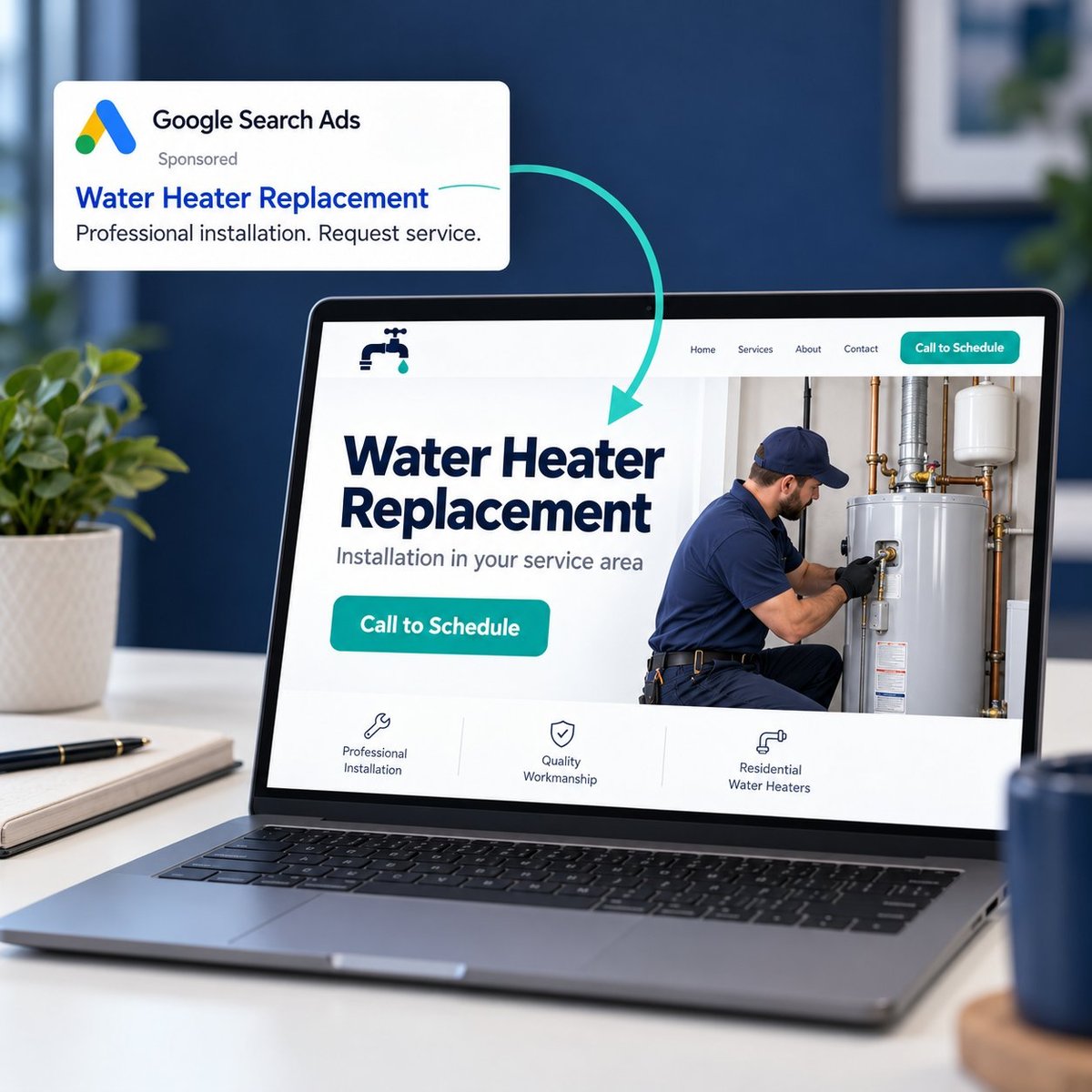
For example, a water heater replacement campaign can connect relevant searches with an ad about your installation service. The homeowner then reaches a page explaining what you offer, where you work, and how to request service.
That connection matters. Someone looking for a replacement water heater should quickly find information about that service.
I’d consider Search Ads first if:
- You want to prioritize specific plumbing services.
- You need more control over your advertising message.
- You have a useful landing page, or can build one.
- Local Services Ads are unavailable or your business cannot meet the requirements.
Search Ads still need ongoing management. Search terms, location settings, conversion tracking, and landing pages all influence whether your spend produces useful opportunities.
When Local Services Ads may be the better starting point
Local Services Ads let homeowners contact your business through a profile. You select available job types and service areas, and Google uses your profile and other auction factors to match and rank your business for searches.
You do not choose individual keywords the way you do with Search Ads.
Before committing to LSA, check eligibility for your service category and market. Required screening and verification vary by category and location and may include license, insurance, or background checks.
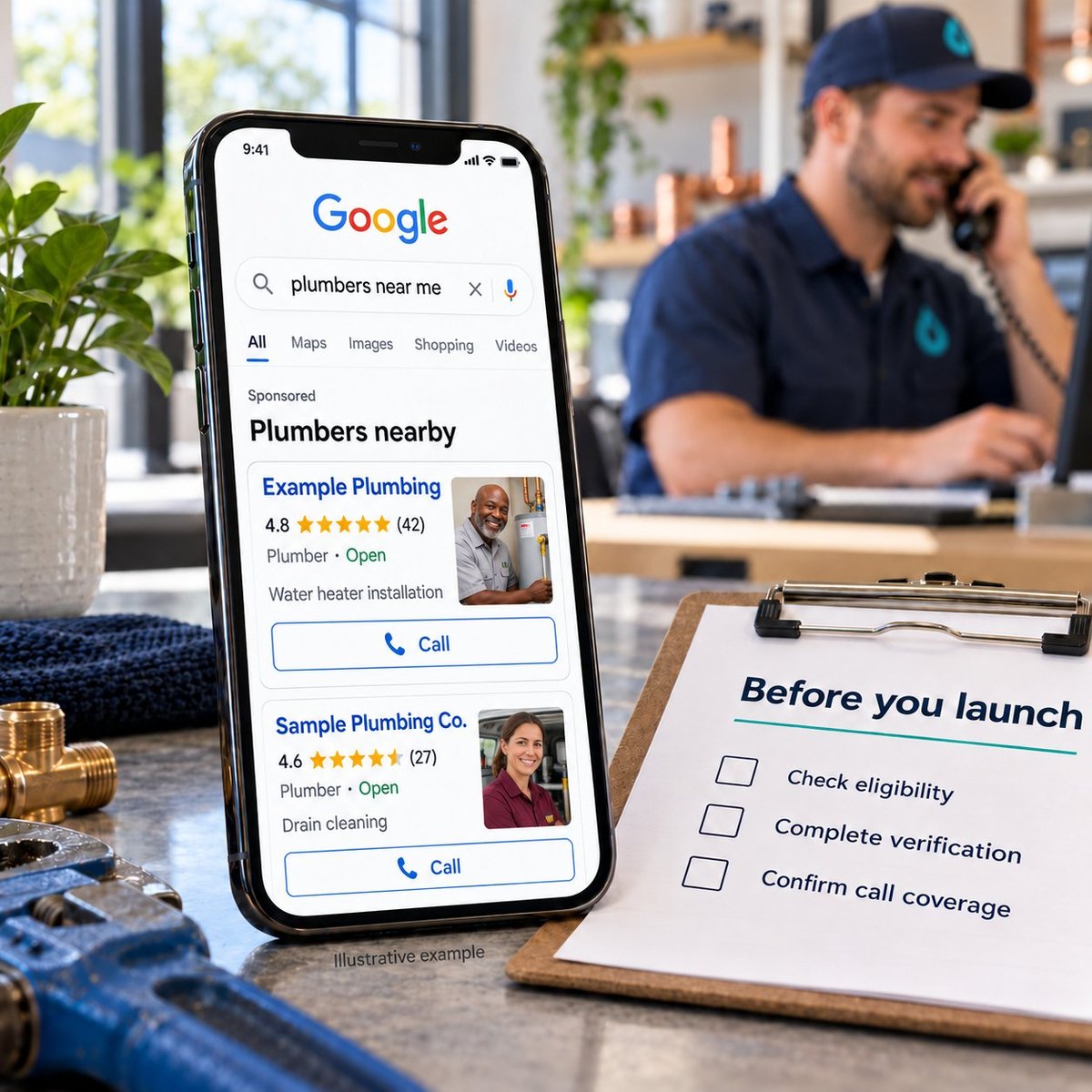
Your profile also needs to compete. Google identifies reviews, profile quality, and responsiveness among the factors that affect ad ranking. A completed profile helps, but consistently answering calls and responding to messages matters too.
I’d consider LSA first if:
- Your business is eligible and can complete verification.
- The available job types match the work you want.
- Your reviews and profile present a strong reason to choose you.
- Your team can respond reliably to incoming inquiries.
LSA can be a useful starting point, but pay-per-lead does not make every inquiry profitable.
How much budget do you need?
There is no universal starting budget for a plumbing company.
A useful test budget depends on local advertising costs, the services you promote, how often leads become customers, and the profit those jobs produce.
With a smaller budget, I’d usually concentrate on one channel first. Splitting limited spend across both can leave each with too little activity to make a confident decision.
Start with a simple question: can this budget generate enough relevant inquiries to evaluate lead quality and booking performance?
A hypothetical example
These numbers illustrate the calculation. They are not a market benchmark or a forecast.
- Monthly ad spend
- $1,500
- Average cost per lead
- $75
- Leads generated
- 20
- Booking rate
- 40%
- Booked jobs
- 8
- Ad spend per booked job
- $187.50
The calculation is simple: $1,500 divided by eight booked jobs equals $187.50 in ad spend per booked job.
That excludes management fees and other marketing costs. Include those when calculating your full acquisition cost.
Also define what counts as a lead. For Search Ads, a tracked call or form submission needs review before you count it as a qualified opportunity. For LSA, a chargeable lead is not necessarily a job your team books.
Compare acquisition cost with job profit
A low-priced repair and a water heater replacement can support very different marketing costs.
Compare what you spend to acquire a customer with what the job contributes after direct job costs. Revenue alone will not tell you whether the advertising works.

For example, a hypothetical job contributing $1,000 before marketing costs leaves $812.50 after $187.50 in ad spend, before management fees and overhead.
Use your own job economics. The cheapest lead may not be the best investment if it produces low-margin work, falls outside your service area, or rarely books.
Make sure your team can answer
Both channels lose value when inquiries go unanswered.
Before launching, decide who handles calls, how missed calls get returned, and how quickly messages receive a response. Make sure your advertising hours and service promises fit your actual availability.
Some missed LSA calls can also qualify for charges—for example, when a customer leaves a voicemail, or when a returned call results in a conversation or voicemail. Pay-per-lead does not remove the cost of poor call handling.
For Search Ads, check the landing page on a phone. A homeowner should quickly understand:
- Which plumbing service you provide.
- Whether you serve their location.
- Why they should contact your company.
- How to call or request service.
A clear page and reliable response process give your advertising a better chance of producing booked work.
When using both channels makes sense
Once one channel produces useful results, adding the other may make sense.
LSA can capture demand for the job types in your profile, while Search Ads support campaigns around your priority services.
You do not need to split the budget evenly. Allocate spend based on profitable booked jobs and your team’s capacity to complete the work.
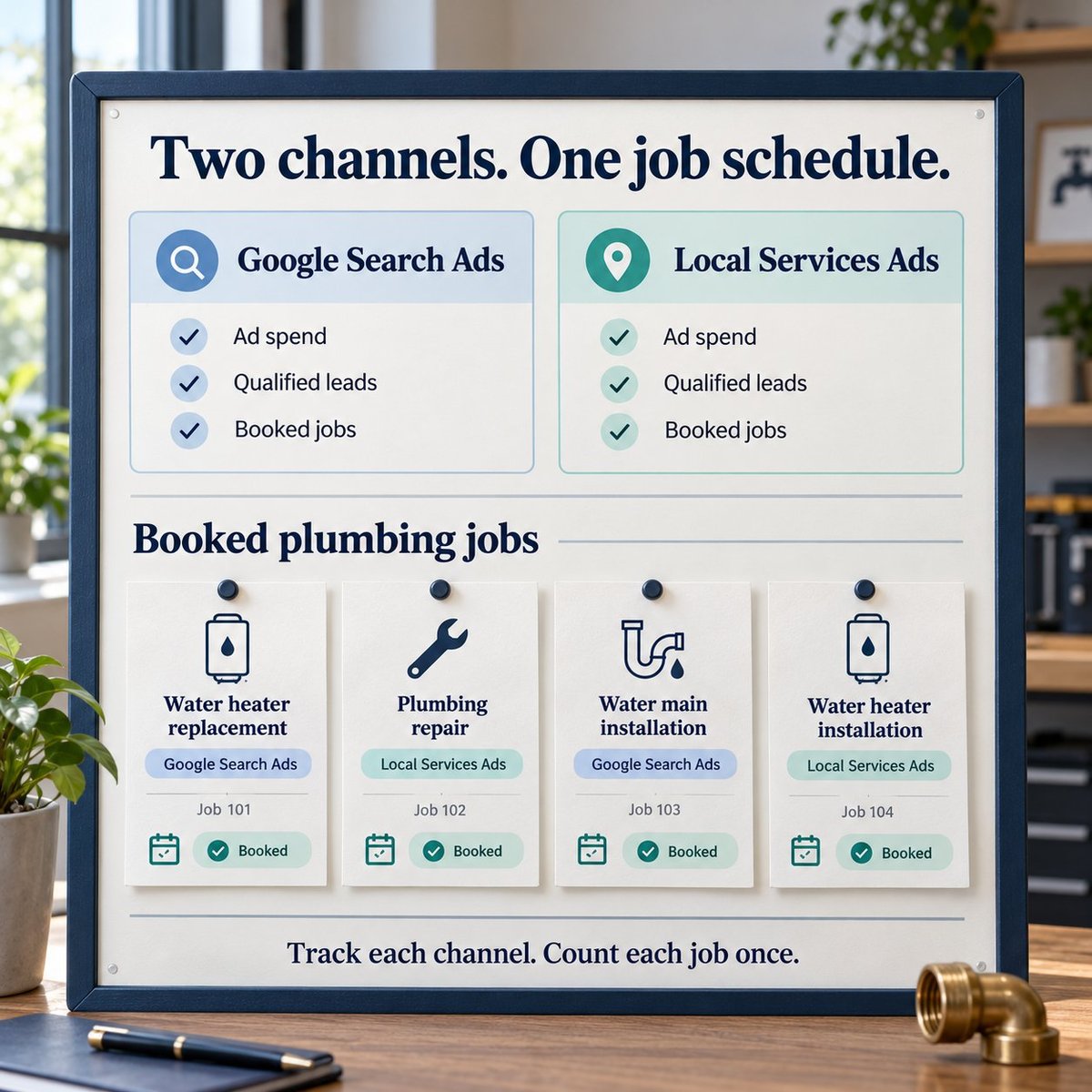
Track each channel separately:
- Ad spend.
- Total inquiries.
- Qualified leads.
- Booked jobs.
- Completed jobs and the profit they produce.
Use call tracking, your CRM, and booking records where available to connect the inquiry with the outcome. Avoid counting the same job twice if a homeowner interacts with both channels.
Which should your plumbing company start with?
I’d lean toward LSA when you’re eligible, your profile is competitive, the job types fit your business, and your team answers reliably.
I’d lean toward Search Ads when you want to prioritize particular services, need more control over the message and landing page, or cannot use LSA.
Before choosing, check four things:
- 1
Eligibility: Can your business run LSA in your market?
- 2
Priority jobs: Which services do you want more of?
- 3
Budget: Can you fund a useful test based on local estimates?
- 4
Call coverage: Can your team respond and book the work?
Choose a starting point, measure what happens, and use booked-job economics to guide the next decision.
Need help choosing a starting point?
At Modern PPC, we help plumbing companies build marketing around the work they want to book.
If you want help evaluating Google Search Ads, Local Services Ads, your budget, and your lead handling, book a marketing assessment.
For the detail behind each channel, see our guides to Google Ads for plumbers and Google Local Services Ads for plumbers. If your campaigns are producing clicks but not booked jobs, the usual culprits are the landing page and lead follow-up.
Sources: Google Local Services Ads overview and How Google Ads charges you. Channel eligibility, billing rules, and ranking factors are set by Google and change over time — confirm current details before budgeting.