
Plumbing lead generation
More leads isn’t the goal. More booked jobs is.
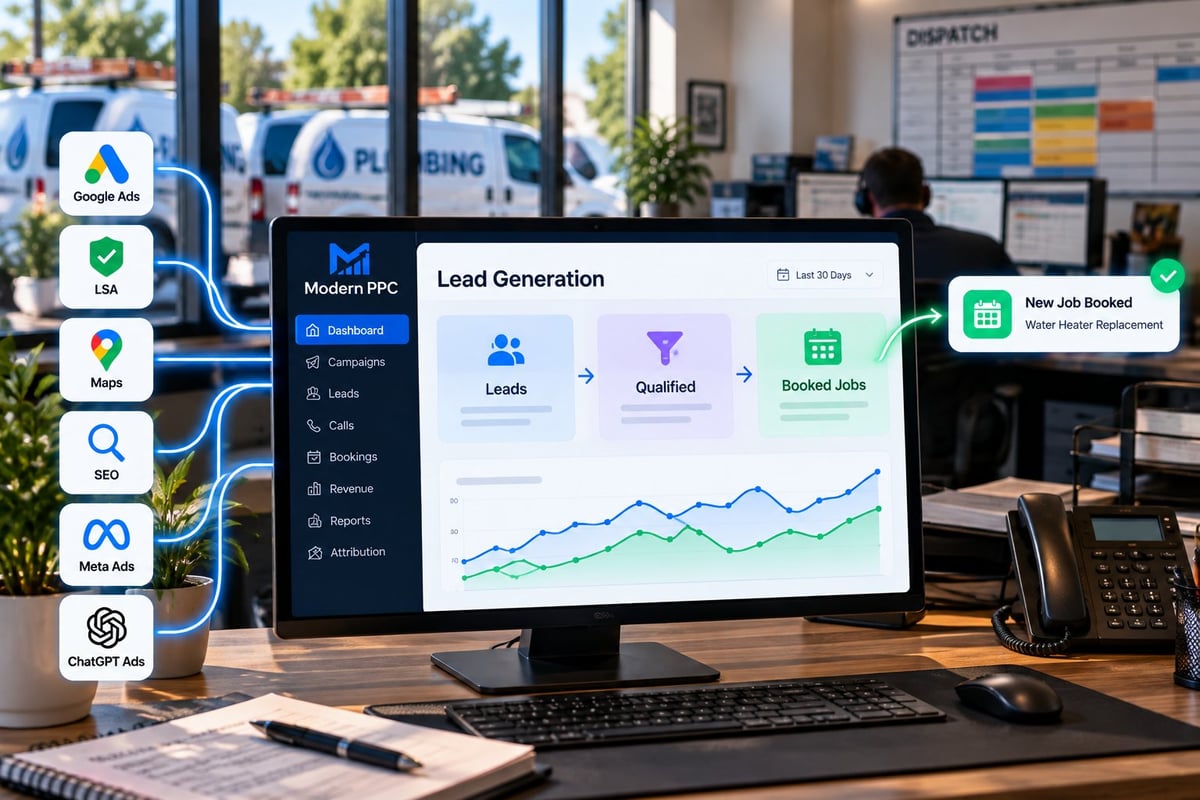
Any agency can send you leads. The number that matters is cost per booked job — total spend divided by jobs that actually landed on the schedule. Those are very different numbers, and the gap between them is where most plumbing marketing budget disappears.
- Google Ads, LSA, Maps, SEO, and Meta
- Cost per lead vs. cost per booked job
- Service and service-area strategy
- Tracking and attribution behind every channel
Cost per lead is only part of the story.
Cost per lead is still a useful marketing metric. It just measures one stage of the process — what it took to make the phone ring, not whether ringing the phone produced work. Each step below gets closer to the outcome a plumbing company actually cares about.
Cost per click
What it cost to get someone to your site or ad. Useful for diagnosing traffic efficiency, and the furthest from revenue.
Cost per lead
What it cost to produce an inbound call or form fill. The number most agencies report, and the one they control most directly.
Cost per qualified opportunity
What it cost to produce an enquiry that actually fits the work you want more of — right service, right area, real intent.
Cost per booked job
What it cost to put work on the schedule. This is the number that maps to revenue, and the one all the others should be judged against.
What we can honestly report
How far down this ladder the reporting can reach depends on what the client’s systems make available. Tracked calls and forms create records with the marketing source attached, and where the CRM connects cleanly, a booked job can be tied back to the channel that produced it. Where a clean connection isn’t possible, we’ll tell you what can and can’t be measured rather than implying a level of precision that isn’t there.
Different Channels Capture Different Types of Plumbing Demand.
No plumbing company needs every channel. Each one reaches homeowners at a different moment and in a different frame of mind, which is why the right mix depends on your market, services, and capacity to service the work.
Google Ads
Captures high-intent searches when homeowners are actively looking for plumbing help right now. The fastest lever available, and entirely dependent on continued spend.
Local Services Ads
Additional Google visibility for eligible local service businesses, carrying the Google Guaranteed badge. Strong trust signal, though lead quality varies and screening is required to run them.
Google Maps
Local visibility at the moment homeowners compare nearby plumbing companies. For many local searches the map pack is the highest-converting real estate on the page.
SEO
Builds organic visibility around the plumbing services and service areas you actually want more of. Slower to establish, but it keeps producing calls without a per-lead cost.
Meta Ads
Creates or captures opportunities through audience-based advertising, offers, retargeting, and planned-work campaigns — reaching homeowners before they have started searching.
What a lead is actually worth to your business.
There isn’t a single number that tells you what you can pay per lead. It depends on how your business actually converts, and it changes as your mix of work changes.
Lead-to-booking and close rates
How many enquiries turn into estimates, and how many estimates turn into scheduled work.
Average job value and gross margin
A larger ticket doesn't automatically mean more room to spend — what matters is what's left after labor, materials, and overhead.
Service mix and repeat business
Emergency drain calls and full repipes have very different economics. Customers who come back change the math again.
Acquisition cost and capacity
What each channel costs to run, and whether you have the technicians to service the work a campaign would create.
We’d rather work this out from your figures than hand you an industry benchmark that doesn’t reflect your market.
From enquiry to booked job
Lead
A call or form fill arrives from one of your channels.
Answered
Someone actually picks up or responds, fast enough to matter.
Qualified
It's the right service, the right area, and real intent.
Booked
It becomes work on the schedule.
The gap between a lead and a job is where budget disappears
Calls that ring out, forms that sit until morning, and estimates that go out and stop. A cheaper lead that nobody answers is more expensive than a pricier one that gets booked.
AI receptionist & missed-call text backWhat about the leads you already have?
New Lead Generation Isn’t the Only Place to Look for Growth.
If your CRM already contains old leads, unsold estimates, and past customers, Modern PPC can also help build campaigns designed to re-engage appropriate existing contacts.
Book a strategy call
Let’s find out where the leads are going.
Tell us a little about your company. We’ll walk through how you currently generate leads and what happens to them after they arrive — then show you where a system would change the outcome.
See where your leads come from today
We'll look at which channels are producing inquiries and what those inquiries actually cost you.
See what happens after a lead arrives
Answer rates, response times, follow-up, and the points where opportunities currently go quiet.
See what working together looks like
A clear picture of the system we'd build for your company, whether or not you decide to move forward.
Lead generation questions.
How do plumbing companies generate more leads?
Most companies jump straight to buying more traffic and skip the levers that usually cost less. The full set is: generate demand across the channels where homeowners are already looking, capture it properly with pages and forms, answer and follow up fast enough that it doesn't go cold, and recover the enquiries that were missed. Where the cheapest gains sit depends on which of those is currently weakest — and that's usually not the top of the funnel.
What is the best lead-generation channel for plumbers?
There isn't one. Google Ads captures people actively searching now. Local Services Ads put you in front of high-intent local demand through Google's platform. Google Maps and SEO build visibility that keeps producing without a per-lead cost, but slower. Meta creates or captures demand with people who weren't searching yet. The right mix depends on your market, services, budget, and how much capacity you have to service the work.
How much should a plumber pay for a lead?
It depends on your numbers rather than an industry benchmark. What you can afford to pay relates to your average job value, your lead-to-booked-job rate, your gross margin, your labor and material costs, your overhead, and what profit you want to keep. A lead is worth less to a company running thin margins than to one running healthy ones, even if they do the same work. We'd rather work it out from your figures than quote a number that doesn't apply to you.
How do I calculate what a plumbing lead is worth?
There isn't one formula that settles it, because a lead's value depends on how your business converts. The factors that matter are your lead-to-booking rate, your close rate on estimates, your average job value and gross margin, your mix of service work, how much repeat business you keep, what each channel costs to run, and how much capacity you have to service the work. Those determine what you can sustainably pay to acquire a customer — not simply the cheapest lead available.
What's the difference between cost per lead and cost per booked job?
Cost per lead tells you what it took to make the phone ring. Cost per booked job tells you what it took to put work on the schedule. A cheap lead that nobody answers is more expensive than an expensive lead that books. Cost per lead is useful as a diagnostic, but it only measures one stage of the acquisition process — which is why we'd rather report closer to the outcome.
Are Google Ads good for plumbers?
For emergency and high-intent service searches, search ads are usually the fastest way to produce calls, because the homeowner is actively looking for help right now. The trade-off is that it's pay-per-click, so the spend is continuous and the results stop when the budget does. It works best when the account is structured around service type, urgency, and the work you actually want more of.
Are Local Services Ads good for plumbers?
They can be, particularly because they appear above regular search ads and can carry the Google Guaranteed badge — meaningful trust for a homeowner deciding who to let into their house. The charging model is based around leads rather than clicks, and eligibility and screening requirements are set by Google and can vary. LSA management is an optional add-on, not part of every package.
Does SEO generate plumbing leads?
Yes, though it works on a different timeline. Maps and organic visibility respond to profile work, reviews, content, and authority, which takes months rather than days to build. The advantage is that it keeps producing after the work is done and isn't priced per lead, which makes it the more durable half of a lead-generation mix when paired with paid channels.
How quickly should plumbing leads be contacted?
Faster than most companies manage, and consistently. Someone with a leaking pipe or a failed water heater is often contacting more than one plumber, so the first business to respond credibly has a real advantage. We'd rather build follow-up workflows that respond immediately by text or call so the outcome doesn't depend on your team noticing an inbox — the exact timing depends on your setup and scope.
Can missed plumbing calls be followed up automatically?
Yes. Missed-call text-back and automated follow-up sequences can respond to a call the business couldn't take, so the opportunity stays warm instead of becoming a voicemail nobody returns. Which workflows are available to you depends on your package and agreed scope.
What about the leads we already have?
That's a separate service rather than an acquisition channel. If your CRM holds old leads, unsold estimates, and past customers, database reactivation campaigns can work those existing contacts instead of buying new ones. The dedicated page covers how that works in full — this page is about creating new opportunities.
How do you track plumbing leads?
Tracked phone numbers and tracked forms create records automatically with the marketing source attached, so leads don't depend on someone remembering to log them. From there the lead sits in a pipeline stage that reflects what's actually happening — new, contacted, estimate scheduled, estimate sent, follow-up due, won or lost.
Does Modern PPC guarantee leads?
No. We don't guarantee lead volume, lead costs, booked jobs, revenue, ROAS, rankings, or conversion rates — marketing results depend on your market, competition, capacity, pricing, and how well the leads are worked. What we can do is build the system, track it properly, and tell you honestly what the numbers are showing.
How much does Modern PPC cost?
Management starts at $2,000/month for the Lead Generation package, with higher tiers at $5,000 and $8,000/month for broader systems, plus one-time setup. Advertising spend is separate and paid directly to the advertising platforms. Google Local Services Ads management is included in Growth System and Market Domination; on Lead Generation it's an optional add-on at $500/month plus $500 setup. The pricing page is the source of truth for what each tier includes.
Is Local Services Ads management included?
In Growth System and Market Domination, yes — both include LSA management alongside Google Ads, Meta Ads and ChatGPT Ads. On Lead Generation, LSA is an optional add-on at $500/month plus a $500 one-time setup, and it also adds $5,000/month to your included managed ad spend. LSA advertising spend is separate and paid directly to Google.
Do I need a CRM?
If leads currently live on a notepad, in an inbox, and in someone's memory, then yes — because the leads you're losing aren't lost in the ad account, they're lost in the gap between arriving and being followed up. A useful CRM holds every lead in one place with a clear next action and the marketing source attached, so nothing goes cold unnoticed and reporting can reach past the click.
Related services
Still deciding?Book a strategy call and we’ll walk through your current setup — no obligation.