Meta Ads for plumbers
Generate demand before the homeowner starts searching.
Google Ads captures homeowners already looking for a plumber. Meta puts your company and offer in front of homeowners before they start calling around.
- Planned-work and high-ticket offers
- Retargeting website and video viewers
- Lead forms and landing page strategy
- Creative testing built for trades
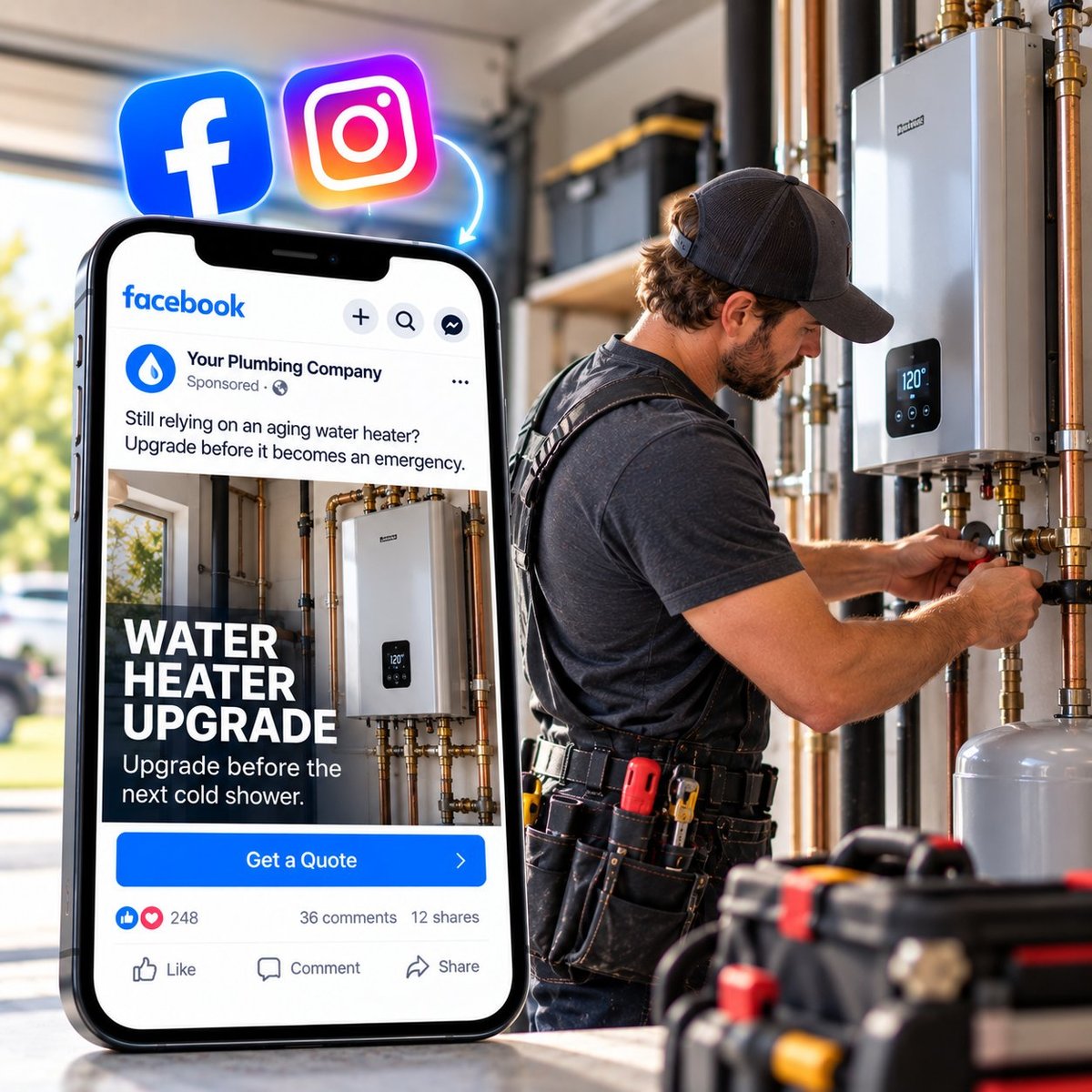
We use Facebook and Instagram advertising to generate opportunities for planned, high-value plumbing work — then connect those leads to the follow-up systems that help turn interest into booked jobs.
Planned Work • High-Ticket Services • Retargeting • Lead Generation • Follow-Up
$30M+
Paid Media Spend Managed
10+ Years
Paid Media Experience
60+
Brands Managed
Plumbing-Focused
Growth System
Deep paid media experience, now applied to a growth system built specifically for plumbing companies. That experience spans brands well beyond plumbing.
What a Meta campaign looks like
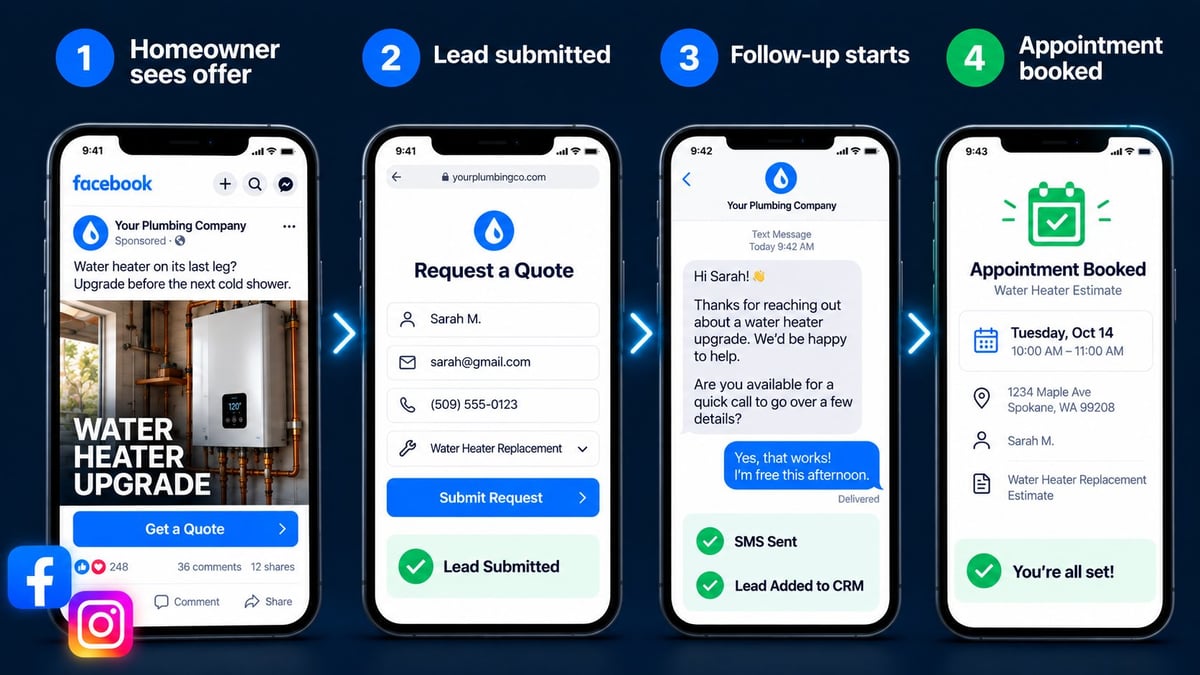
An offer, in front of the right homeowner.
Social advertising works when there’s a specific reason to stop scrolling. Here’s the shape of a planned-work campaign — offer, capture, follow-up, booked job.
Homeowner sees offer
A relevant, specific offer while they're scrolling.
Lead submitted
They raise a hand through a form or landing page.
Follow-up starts
The inquiry is handled and worked, not left to sit.
Appointment booked
Interest turns into a slot on the schedule.
Honest scope
Where Meta fits — and where it doesn't.
Being honest about this is more useful than pretending social advertising is a fit for every plumbing job. It isn't.
Where it works
High-ticket planned work
Water heater replacement, whole-home repipe, bathroom remodels, sewer line work — decisions people deliberate over rather than make in a panic.
Maintenance plans
A recurring offer with a clear benefit suits social advertising, because it rewards consideration rather than urgency.
Seasonal campaigns
Pre-winter water heater and pipe checks — reaching people before the season creates the emergency.
Retargeting
Visitors who came to your site and didn't call, because they already know you.
Where it doesn't
Emergency searches
Someone with water pouring through a ceiling is not on Facebook. Emergency demand belongs in Google Ads and Local Services Ads.
Generic brand ads
'Call us for all your plumbing needs' gives nobody a reason to act. Without a specific offer, social advertising just generates impressions.
As a replacement for search
Meta creates demand; it doesn't capture existing demand. Treating it as a substitute for Google Ads means competing for attention instead of intent.
Google captures existing demand.
Meta helps create and nurture demand.
The offer
What would we actually advertise?
Meta works best when there's a specific reason for the homeowner to stop scrolling and pay attention.
Offer concept
Water heater replacement
Is your water heater approaching replacement age?
- Replacement options
- Financing availability
- Installed-price consultation
- Tank vs. tankless comparison
Offer concept
Whole-home repipe
Dealing with recurring leaks, low pressure or aging plumbing?
- Repiping consultation
- Financing options
- Home plumbing assessment
Offer concept
Sewer / drain projects
Recurring sewer problems don't always need another temporary fix.
- Inspection
- Replacement options
- Financing
- Consultation
Offer concept
Maintenance plan
Prevent small plumbing problems from becoming expensive surprises.
- Annual inspection
- Priority scheduling
- Defined membership benefits
Offer concept
Seasonal offer
Get your plumbing system ready before freezing temperatures arrive.
- Outdoor plumbing preparation
- Water heater checks
- Sump pump checks where relevant
- Seasonal inspection
These are examples of the types of offers we may test, based on your market and the services you actually provide. Not every plumbing company should run every offer — and we wouldn’t recommend one you can’t deliver well.
Not sure what your plumbing company should advertise?
We'll look at your service mix, average job values, market and current marketing to identify where Meta may — or may not — make sense.
Free strategy call • No obligation
How we run it
How we run plumbing campaigns on Meta.
Six things that decide whether a social campaign produces real opportunities or just impressions.
Six things that decide the result
Applies to every campaign we run
- 01
Lead with a real offer
A specific installed price, a financing option, a defined seasonal service. Something a homeowner can evaluate, not a vague invitation to get in touch.
- 02
Target the service radius properly
Tight geographic targeting around the areas you actually serve, with exclusions for where you don't go. Broad reach outside your radius is wasted spend.
- 03
Test creative relentlessly
Real technicians, completed jobs, equipment, educational videos, customer-focused offers and other creative concepts can all be tested. We use performance data to determine which messages and creative formats deserve more budget.
- 04
Native lead forms vs. landing pages
Native forms get more submissions; landing pages filter for quality. Which is right depends on the offer and the ticket size, and it's worth testing both.
- 05
Respond immediately
Meta leads often require active follow-up. The faster and more consistently a new inquiry is handled, the better the opportunity to move that homeowner toward a real conversation.
- 06
Measure against booked jobs
Same standard as everything else: what happened after the form was submitted. Lead volume without that context tells you nothing.
The part most agencies skip
Generating the lead is only half the job.
A homeowner who fills out a Facebook or Instagram form may be interested without being ready to call immediately. That makes the follow-up process especially important.
The follow-up chain
Eight stages from ad to booked job
01
Meta ad
02
Lead submitted
03
CRM
04
Immediate response
05
SMS / email follow-up
06
Appointment booking
07
Estimate follow-up
08
Booked job
Modern PPC can connect paid social campaigns to the CRM, AI answering and automated follow-up systems used in our Growth System.
Lead Generation
Meta campaign management and lead generation.
Growth System
Adds CRM, AI answering and booking, automated follow-up and additional conversion systems.
That's why we think about lead generation and lead follow-up as parts of the same system.
Different jobs
Meta and Google do different jobs.
Neither is better in the abstract. They work on different moments in a homeowner's decision, and the mix depends on the work you want more of.
Google Ads
- Homeowner intent
- Already searching
- Best for
- Existing demand, emergency jobs, immediate service needs, high-intent searches
- Role
- Capture demand
Meta Ads
- Homeowner intent
- Not necessarily searching yet
- Best for
- Planned projects, high-ticket services, offers, retargeting, maintenance, seasonal campaigns
- Role
- Create and nurture demand
Strong plumbing marketing doesn't force one channel to do every job.
Google Ads captures demand. Meta expands demand. Follow-up helps convert it.
The metric that matters
Cheap leads aren't the goal.
Profitable booked jobs are.
Meta can generate inexpensive form submissions that never become real opportunities. That's why lead cost alone doesn't tell the whole story.
We want to understand what happens after the form is submitted: contact, qualification, appointment and ultimately the booked job.
From ad spend to booked job
Only the last one pays for a truck
STAGE 01
Ad spend
STAGE 02
Leads
STAGE 03
Qualified opportunities
STAGE 04
Appointments
STAGE 05
Booked jobs
The metric we optimize toward
Cost per booked job
The business metric the system is designed to work toward.
Attribution depends on the tracking and systems in place. Where a clean connection from ad to booked job isn’t possible, we’ll tell you what can and can’t be measured rather than implying precision that isn’t there.
The process
What happens when we run Meta Ads for your plumbing company?
Four stages, in order.
Choose the offer
We look at your services, job values, margins, seasonality and capacity to determine what is worth promoting.
Build the campaign
We develop the campaign structure, targeting, messaging, creative direction and lead-capture experience.
Test & learn
We test offers, creative and lead-capture approaches to understand what is generating useful opportunities.
Optimize toward real outcomes
We use lead quality and downstream conversion data where available to make better budget and campaign decisions.
Modern PPC Lead Generation
Meta Ads management for plumbers
Lead Generation starts with Google Ads. Add Meta Ads for +$1,000/month and +$750 setup. Growth System and Market Domination include both from the start.
Monthly
$2,000
per month
Setup
$1,500
one-time
First month: $3,500 + ad spend
- Meta Ads management
- Campaign strategy and management
- Conversion, call and lead tracking where applicable
- Ongoing optimization and monthly reporting
- Advertising spend is separate and paid directly to Meta
A 10% management fee applies only to combined managed ad spend above the included threshold. Standard management fee cap: $7,500/month. Prices shown are the current published rates.
Need us to help convert the leads too?
Lead Generation manages Google Ads, with Meta Ads, Google Local Services Ads and ChatGPT Ads available as add-ons. Growth System includes all four channels as standard, plus the CRM, AI receptionist, appointment booking, missed-call text-back, automated nurture, estimate follow-up, reactivation and review systems.

Who runs your account
Your ad budget isn’t being handed to a generic social media team.
Modern PPC was built by a paid media and performance marketing strategist with a decade of experience and more than $30M in managed ad spend across ecommerce and lead-generation accounts.
That performance-marketing mindset goes into a growth system built specifically for plumbing companies.
See if Meta ads fit
See If Meta Ads Fit My Company
Let's work out whether Meta belongs in your mix, and what it would take to run it profitably for the work you actually want.
We'll look at the work you want more of
Meta suits planned and high-ticket work better than emergencies — we'll check whether that's a fit.
We'll look at what you're running now
Current creative, audiences, and offers, and what's holding performance back.
You'll see what we'd test first
A clear picture of the campaigns worth building, and what success would look like.
Meta ads questions, answered honestly.
Including the ones that decide whether Meta belongs in your budget at all.
Do Facebook ads work for plumbers?
For emergency work, no — nobody scrolls Facebook hoping their water heater breaks. But for planned, higher-ticket work they can work well: water heater replacements, repiping, remodels, and maintenance plans are decisions people do deliberate about, and Facebook and Instagram are where they spend time. The mistake is judging Meta by the same standard as Google Ads, when the two are doing different jobs.
What's the difference between Google Ads and Facebook ads for a plumbing company?
Google Ads captures demand that already exists — someone is actively searching for a plumber right now, so it's generally the right place for emergency and immediate service needs. Meta creates and nurtures demand by putting an offer in front of homeowners who weren't looking yet, which suits planned projects, high-ticket services, maintenance and retargeting. Neither replaces the other; the right mix depends on your services, market, budget and capacity.
What kind of plumbing offers work on Facebook?
Specific, high-value and easy to understand. A water heater replacement with clear options, a whole-home repipe with financing available, a maintenance plan with a defined benefit, or a seasonal service. What generally doesn't work is a generic 'call us for all your plumbing needs' ad — that gives someone no reason to act now.
How much does Modern PPC Meta Ads management cost?
$2,000 per month, plus a one-time $1,500 setup. That's our Lead Generation package, which includes Google Ads management and up to $10,000/month in included managed ad spend — Meta Ads can be added for +$1,000/month and +$750 one-time setup. Advertising spend itself is separate and paid by you directly to Meta.
Is ad spend included?
No. Advertising spend is separate from Modern PPC's management fee and is paid by you directly to Meta. We don't mark it up or take a percentage of it.
Should I run Google Ads or Meta Ads?
Google is generally designed to capture existing search demand — someone actively looking for a plumber. Meta is generally better suited to generating or nurturing demand around planned work, offers and retargeting. The right mix depends on your services, market, budget and capacity, which is what a strategy call is for.
Can I run both Google and Meta?
Yes. Lead Generation starts with Google Ads, and you can add Meta Ads at any point for +$1,000/month and +$750 one-time setup. Growth System and Market Domination already include Google Ads, Meta Ads, Google Local Services Ads and ChatGPT Ads from the start.
Do Meta leads need a CRM?
A CRM isn't technically required to run Meta Ads. But as lead volume grows, organized and consistent lead handling becomes increasingly important — leads that aren't tracked tend to be leads that aren't followed up. CRM and automated follow-up are available through our Growth System.
Can Modern PPC help with follow-up?
Yes, through the Growth System package. That adds the CRM, AI receptionist, appointment booking, missed-call text-back, automated SMS and email nurture, estimate follow-up, reactivation and review systems — the pieces that handle what happens after a lead arrives.
How long before Facebook ads produce plumbing jobs?
Meta usually requires more testing than high-intent search, because you're interrupting attention rather than responding to an active search. Early campaign data helps us evaluate the offer, creative, targeting and lead quality. How quickly a campaign produces consistent opportunities depends on the market, service, offer, budget, creative and follow-up process. We evaluate Meta based on the quality and economics of the opportunities it creates — not on an arbitrary timeline.
What happens during the first 90 days?
It takes time to launch, gather real data and improve performance, so we begin with a 90-day initial engagement. In that window we build the campaigns, test offers and creative, and start collecting lead-quality data to guide the next round of decisions. After the initial 90 days, service continues month-to-month with 30 days' written notice.
Related services
Meta is one part of the growth system. These are the others.
Still deciding?Book a strategy call and we’ll walk through your current setup — no obligation.